

How To Change Image Size In Indesign
Raise Image Resolution Directly in InDesign
[Editor'southward note: This is an article submitted for your enjoyment by InDesign skillful Branislav Milic, who runs a wonderful French-linguistic communication InDesign site. It'south an interesting technique that reveals a fascinating and rarely explored attribute of the transparency flattener.]
It is sometimes difficult for users to foresee paradigm resolution and dimensions they volition need while they are laying out an InDesign certificate, and information technology is particularly difficult to set up the images' output resolution to 300 ppi during the layout process. Very often, some images, due to numerous scalings upwardly and downward during the layout, take an effective resolution of less than 300 ppi, and that resolution is passed through to the print-gear up PDF–a quality that you lot usually accept. However, when the PDF is received by the prepress operator of a newspaper or a mag, it is typically checked in a preflight tool such equally Enfocus PitStop or Adobe Acrobat Pro — which will warn that the resolution of some images is not 300 ppi! The result: the operator also-often sends the PDF back to its creator.
Then, how to fix the resolution without opening each image in Photoshop, peculiarly when there are dozens or even hundreds of images involved? Very simple… just force InDesign to raise the resolution to 300 ppi! Here'southward how to do it.
1. In Photoshop, create a document with the post-obit specifications:

More than later the spring! Continue reading beneath ↓
Free and Premium members run into fewer ads! Sign up and log-in today.
- The dimensions must be the same as the InDesign document. Also pay respect to the orientation of the InDesign document. If it is oriented in Portrait mode, do the aforementioned in the Photoshop file.
- Set the Resolution to 300 ppi.
- Fix the Color Mode to CMYK.
- In Background Contents, fill the Photoshop file with a white background. In fact the type of file, the fact that information technology is flattened or layered does not matter at all.
ii. Save the file. It can be a JPEG, merely do not include whatsoever ICC profile. Name the certificate something like "White Groundwork.jpg".
3. In your InDesign document, it is of import that the images and the texts are wisely distributed amidst layers. All the images should have been placed on the "Images" layer, and all the texts should have been placed on the "Text" layer. I recommend that the "Text" layer is placed above the images, and more than specifically above all the other objects using transparency options (opacity of less than 100%, blending mode, furnishings,etc) otherwise the flattening engine will sandwich the texts and raster/outline them.
iv. Bound to a master page that has an influence on all the other certificate or primary pages.
5. Create a layer called something like "Resolution" that you lot will position above the "Images" layer merely beneath the "Texts" layer!
6. On that main page and on that layer, import the "White Background.jpg" file and then it covers the whole InDesign document. If the document has been created with a master page having an influence on all the other master pages, all the images of the document volition now suddenly exist hidden. If some images are even so visible, this ways that some principal pages are independent. Thus place the "White Background.jpg" on each master page so none images are visible.
seven. Using the Selection Tool (Blackness Arrow), select the graphic frame that contains the "White Groundwork.jpg" and modify its blending mode to "Multiply" in the Effects panel. Now all the certificate's pages display properly again. What you have done here is placed a 300 ppi transparent object which covers the whole document. When the transparency flattener will blend the images, information technology will use the resolution of the highest image file in the pile and will alloy all the images at its resolution — thus 300 ppi.
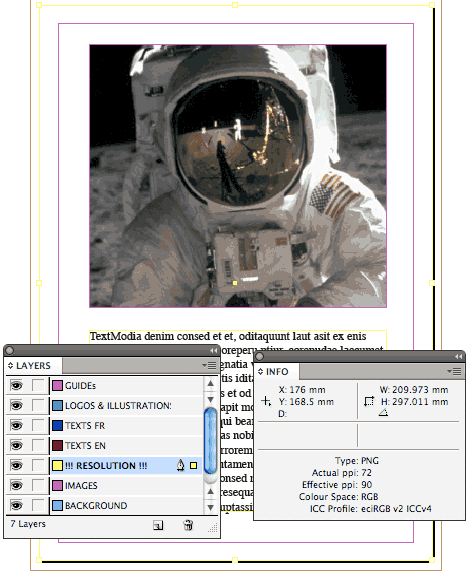
8. For example, in the image below, I have placed a 72 ppi screenshot merely nether the "White Background.jpg" graphic frame. This screenshot is slightly scaled down then its resolution is increased upwardly to 90 ppi.
9. Consign the InDesign document as a PDF (or create a PostScript file that you will place into the Distiller) and choose the PDF-X/1a:2001 preset or whatever other method that invokes the transparency flattener (the Acrobat iv, PDF i.3 format).
x. Open the resulting PDF in Adobe Acrobat Pro. Choose Advanced > Print Production > Preflight. Amongst the three lilliputian squares on superlative of the palette, select the one in the middle "Select Unmarried Checks". In the list of presets, select the ane in the Images department named Resolution of color and grayscale images is greater than 250 ppi.
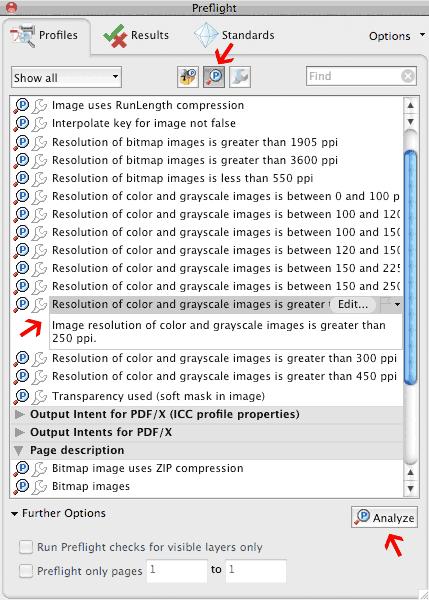
eleven. Select and double-click this preset or click the "Clarify" button in the lower correct corner: you'll notice that Acrobat displays a alert.
12. Click on the picayune gray arrow next to the scarlet cross to reveal the list of images and y'all will detect that they all have a resolution of 300 ppi.
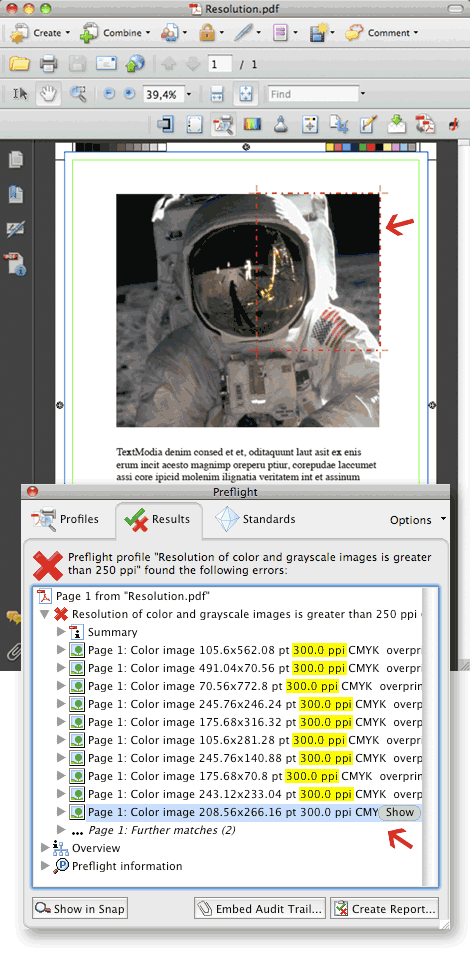
There announced to be a lot of images because the transparency flattener has created a jigsaw-puzzle of flattened and contiguous images that have no influence on the texts and vector shapes in a higher place.
Notation #1: if y'all want to increase the resolution from 300 ppi up to 450 ppi, only open up the "White Background.jpg" file in Photoshop and increment its resolution to 450 ppi (Epitome menu > Paradigm Size). Save the file, go back to InDesign and update the link. Re-consign and savor this play a joke on!
Note #ii: To calibration images, InDesign uses the legendary Bicubic Interpolation Algorithm that has been present in Adobe software for years. Nosotros can thus expect a very skillful resampling quality. Remember: this trick is only actually intended to fool the preflight tools when yous're besides lazy to adjust the effective/output resolution of each image in Photoshop.
Note #3: If you lot are working in a unflattened workflow (Acrobat five – PDF i.4 or higher), the flattening of transparency will be executed by an Adobe Certified RIP or manually via the "Control Flattener Setting" on the Preflight panel (in Acrobat).
Annotation #iv: Zevrix'due south Link Optimizer for InDesign is a fantastic utility to control the output resolution of images in InDesign document (and other epitome formatting changes).
Brussels based Branislav Milic is an Adobe Certified Expert and Trainer. He travels all over Europe and the United states of america to host seminars, trainings, and to implement circuitous but efficient publishing workflows. His website has been covering all-things-InDesign in the French language since the release of InDesign ane.0 in September 1999.

How To Change Image Size In Indesign,
Source: https://creativepro.com/raise-image-resolution-directly-in-indesign/
Posted by: farrisanny1958.blogspot.com
0 Response to "How To Change Image Size In Indesign"
Post a Comment